
One of the biggest challenges with manufacturing automation is knowing how a new system will perform before it is installed. Digital twins help reduce that uncertainty by creating virtual representations of physical systems that can incorporate historical and operational data.
These models give manufacturers a clearer view of how automation may perform under real-world conditions, helping identify potential implementation, integration, and performance issues before they become costly problems. The result is better visibility, fewer surprises during deployment, and a lower risk of downtime or rework.
What Is a Digital Twin in Manufacturing?
Digital twins are virtual representations of physical assets, processes, or systems that are connected to real-world data. Depending on the application, they can incorporate historical operational data, live data, or both to model and evaluate real-world performance and even anticipate future challenges or conditions.
Digital twins bring virtual representations to many industries but are particularly useful in manufacturing, where digital twins represent machines or even production lines. In practice, digital twins in manufacturing feature interactive versions of machinery or production processes, fed with historic production data or details about various operating conditions.
How Does a Digital Twin Differ from Simulation or 3D Modeling?
Digital twins hold some definite similarities with simulations, including the ability to model system behavior under defined conditions. Differences come down to the data behind those models and how that data is leveraged. Simulations can use hypothetical scenarios or real operating data, but they typically model a defined scenario without maintaining an ongoing connection to the physical system. A digital twin ties the virtual model more directly to real-world assets, processes, and operational data.
Compare this to 3D scans or CAD: these tools show what systems or processes look like, but while they capture layouts and dimensions, they tell us little about how equipment actually performs amid changing production conditions. With digital twins, operational data, which can include IoT sensor input, adds context to the virtual model. This replaces static representations with dynamic models, enabling teams to tailor automation based on actual production demands.
Common Automation Risks Digital Twins Can Help Address
Digital twins help manufacturers overcome several challenges that might otherwise prevent businesses from fully embracing automation.
- Integration challenges. Automated solutions strive to connect several technologies that may not have originally been designed to work with one another. Legacy systems, for example, require new sensors along with updated communication hardware or converted data formats. Without proper integration, expected automation gains may not materialize; poor coordination between systems can create bottlenecks, disruptions, or throughput issues.
- Underperformance. Automated systems can lead to significant improvements in efficiency, throughput, and accuracy but sometimes fall short because they do not fully account for physical challenges within real-world manufacturing environments.
- Downtime and disruptions. As manufacturers implement and test automated solutions, they can experience temporary interruptions to production. Further delays are possible if unexpected integration issues call for adjusted processes.
- Budget and timeline issues. Automation projects can exceed anticipated costs if they bring additional problems to light and especially if they are poorly planned. These issues lead to change orders and other delays but can also increase expenses if rework is required.
How Do Digital Twins Reduce Automation Risk?
Digital twins directly address many of the core concerns tied to manufacturing automation — especially upfront challenges that cause disruption or otherwise diminish the ROI of new automation initiatives. Advantages include:
Reducing Integration Complexity
New automation often needs to fit around existing layouts, conveyors, workflows, equipment, and space constraints. Digital twin validation allows teams to model how a proposed system will interact with that existing environment before installation, helping surface compatibility or workflow issues earlier.
Validating Throughput Before Deployment
Projected throughput for automation systems can sometimes be overstated, particularly when estimates rely on idealized specifications or cycle times that don’t fully reflect real operating conditions. If production lines fail to uphold these projections, manufacturers face weaker-than-anticipated ROI and may also see operational disruptions: unexpected bottlenecks along with the accumulation of work-in-progress (WIP).
Digital twins can support more realistic throughput projections, showing where improvements are possible but also tempering expectations according to real-world challenges and variabilities that exist even after automated strategies are implemented. Through digital twin validation, manufacturers can test whether projected throughput holds up under realistic product mixes and operating conditions before deployment.
Avoiding Costly Rework, Downtime, and Change Orders
Errors are far easier (and less expensive) to correct when caught virtually, before they demand real-world equipment modifications or other costly physical changes. Digital twins uncover design and integration issues well in advance, enabling proactive solutions when they’re most cost-effective and most easily achieved through digital adjustments.
If these problems are spotted and resolved before commissioning or installation, rework and change orders can be avoided.
Testing System Performance Against Real-World Variability
Digital twins reveal how automated systems function under real-world conditions, and, while this advantage is often tied to throughput projections, it also impacts other markers of successful production: cycle times, buffer levels, and material flow, for example. Product variability is a common challenge in manufacturing and warehouse environments, where dimensions, packaging, order mixes, and production demands can change frequently.
Prior to automation deployment, manufacturers can use digital twins to experiment with different product mixes or dimensions. They can even adjust operational conditions to reflect likely scenarios: sudden surges in demand or changes to product sequencing. These tests reveal potential bottlenecks or other performance concerns and allow teams to adjust accordingly.
Use Cases for Digital Twins in Manufacturing and Warehouse Automation
The value of digital twins in manufacturing extends beyond risk management to encompass many use cases:
- Predictive maintenance. Virtual models and continuous performance data allow manufacturers to spot early signs of equipment deterioration and arrange for servicing or repairs before major breakdowns cause disruptions. Critical equipment continues to run reliably and downtime is reduced.
- Equipment and process monitoring. Digital twins improve visibility into equipment and process performance. Teams can monitor automated conveyors or palletizers, examining cycle times, accumulation, and other operating data to identify slowdowns and determine whether processes are keeping pace with demand.
- Facility and layout planning. Automation yields limited improvements when facilities are poorly designed and especially when equipment placement impedes access or creates bottlenecks. Digital twins reveal optimal equipment locations prior to physically moving machinery.
When Should You Use a Digital Twin for an Automation Project?
Not all projects call for digital twins, but these representations make sense when the challenges of automation threaten to limit ROI. Digital twin validation is especially valuable in these situations:
- Evaluating initial warehouse automation investments. Build confidence in automation investments through digital twin-supported evaluations. This approach removes operational guesswork while moving beyond strictly theoretical evaluations. Digital twin validation can use historical operational data to provide a more realistic view of how proposed automation may perform. Through validation, teams get a better sense of potential productivity gains while identifying implementation challenges that could affect deployment. These details are key to successfully weighing operational improvements against significant upfront investments.
- Dealing with brownfield environments. Digital twins allow for continuity within existing facilities. These models show how automation impacts actual workflows. Issues with space or compatibility come to light early on and can be addressed without fully upending established processes.
- Managing product variability. Automation performance can be difficult to predict due to differences in dimensions and packaging — not to mention, diverse or fluctuating product mixes. Rather than validating automation against a ‘typical’ product, digital twins test many production scenarios. Teams look to them to confirm how changing products impact automated system performance.
- Throughput guarantees. Throughput targets can be difficult to meet when the realities of the physical environment fail to match underlying assumptions. Digital twins put those projections to the test.
Digital Twins in Action: Validating Mixed-Case Palletizing with Jacobi Robotics
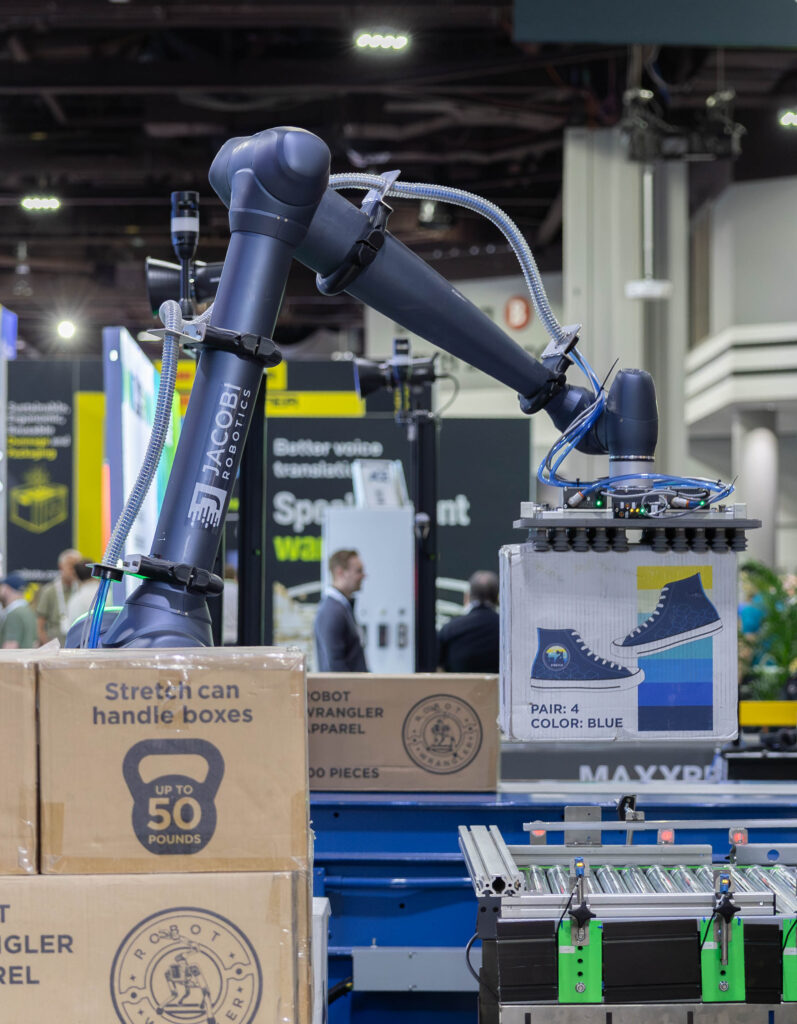 A recent partnership between Peak Technologies and Jacobi Robotics shows how manufacturers and warehouses can improve efficiency while navigating variable product mixes and evolving production demands.
Jacobi’s OmniPalletizer solution supports brownfield environments by integrating mixed-case palletizing into existing facilities. Its onboard digital twin can use a customer’s actual SKU history and order mix to validate throughput, pallet quality, ROI, and expected system performance before deployment. This gives teams a clearer picture of both limitations and opportunities before committing to installation.
The partnership pairs Jacobi’s palletizing and digital twin technology with Peak Automation Intelligence’s (Peak Technologies automation division) systems engineering, enterprise technology integration, on-site integration, and lifecycle support. Together, this provides a practical path for introducing mixed-case palletizing automation into complex warehouse environments while reducing integration and commissioning risk.
Reduce Automation Risk with Peak Automation Intelligence and Jacobi Robotics
Capture the full value of smart manufacturing through digital twin technology. Look to Peak Automation Intelligence and Jacobi Robotics for proactive support as you plan and implement automated solutions. Get started and speak with a warehouse automation expert today.